

New book Explains Managing the Fear or Joy of Missing Out, a Feeling Every Generation Shares, From Teens to Retirees
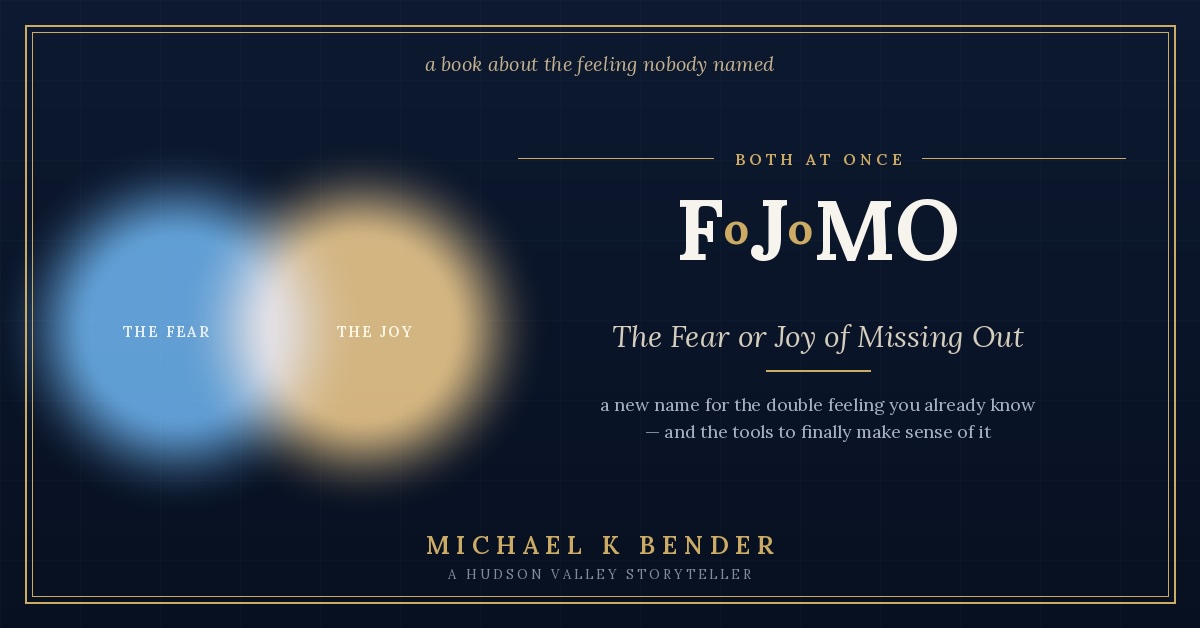
The Fear or Joy of Missing Out
"The Fear and Joy of Missing Out" shows readers that both have always arrived together, and offers a practical way to make sense of both
Nobody tells you that missing out can feel good. For years, people have treated fear as the problem and joy as the cure, when really both are simply telling you something true.”
CAIRO, NY, UNITED STATES, September 21, 2026 /EINPresswire.com/ -- A teenager watches her friends' weekend unfold one photo at a time on her phone and feels her stomach drop. A few years later, her father notices his own son didn't think to invite him along, and beneath the sting, feels an unexpected flicker of pride. A woman who buried her husband the previous spring sits down to an ordinary Tuesday afternoon and catches herself feeling, of all things, at peace. Three different ages, three different rooms, and the same feeling landing in each of them at once.— Michael K Bender
For roughly a decade, that feeling has been split into two competing camps: FOMO, the anxious fear of missing out, and JOMO, the supposedly wiser joy of missing out, treated as a cure for the first. Author Michael K. Bender's new book, "The Fear and Joy of Missing Out: A New Way to Understand a Feeling Everyone Has," argues that this framing has never told the whole story. Fear and joy about the same missed moment do not take turns, Bender writes; they arrive together, and that is not a malfunction to correct but information worth listening to.
Bender calls the combined experience FoJoMo, the simultaneous and entirely normal fear and joy of missing out. The book builds its case around true-to-life scenarios spanning decades of life, including a retired teacher adjusting to a newly empty schedule, a search-and-rescue volunteer torn about taking a weekend off, a father watching his teenager grow more independent, and a widow rebuilding an ordinary day from scratch. Whether the trigger is a group chat, a graduation, a diagnosis, or an empty nest, the underlying feeling and the tools for handling it well are shown to be much the same.
"Nobody tells you that missing out is allowed to feel good," said Bender. "For years, the fear has been treated as the problem and the joy as the cure, when really both are simply telling you something true. This book is not about getting rid of either feeling. It is about understanding both of them well enough to choose on purpose, whether a reader is fifteen, fifty, or eighty."
The book is aimed squarely at that range. Teenagers and young adults, for whom a phone rarely turns off, are shown how to tell a genuine loss from a scrolling habit. Parents and grandparents watching children grow more independent are offered language for a pull that is easy to dismiss or to drown in. Midlife readers weighing what still deserves a yes and what has earned a no are given a framework for the decision. Retirees and empty-nesters rebuilding a full life after decades of a full calendar are shown why quiet so often feels like loss before it feels like freedom. Readers who have grieved or started over are addressed directly with a question many of them ask quietly: whether feeling good about moving on means something is wrong with them.
Alongside its central idea, the book offers tools to use the moment the feeling shows up. The Split is a sixty-second habit for naming both voices before they shape the rest of an evening. The Ledger offers four honest questions to weigh what a decision costs. A simple, repeatable filter helps you build a life around personal priorities rather than whatever a feed happens to surface. A set of appendices, including a one-page quick reference, a thirty-day practice plan, and a discussion guide suited to classrooms, book clubs, and teams, helps turn the idea into an ongoing habit rather than a single read.
"The Fear and Joy of Missing Out: A New Way to Understand a Feeling Everyone Has" is available now in paperback and Kindle editions on Amazon. https://www.amazon.com/dp/B0HKB1YNXC
Michael K. Bender spent his career as a corporate CEO, international marketing executive, and United States Foreign Commercial Officer, with postings in Nigeria, Saudi Arabia, Kuwait, the United Kingdom, China, and West Germany. After retiring, he taught English literary skills in After School Enrichment programs and taught English as a Second Language to employees of international organizations in Washington, D.C. He now writes full-time from Cairo, New York.
Media Contact: Michael K. Bender, michael@mkbender.com
Michael Bender
Michael K Bender
+1 518-704-1688
email us here
Legal Disclaimer:
EIN Presswire provides this news content "as is" without warranty of any kind. We do not accept any responsibility or liability for the accuracy, content, images, videos, licenses, completeness, legality, or reliability of the information contained in this article. If you have any complaints or copyright issues related to this article, kindly contact the author above.
